

For the past few months, and honestly years, the internet has been flooded with negative narratives about AI. If you scroll through any social media like X or LinkedIn, it feels like every major “exit” or leadership change is framed as a sign of impending AI doom.
Recently, a viral Substack essay titled “THE 2028 GLOBAL INTELLIGENCE CRISIS” painted a vivid scenario where the global economy is upended by the rapid rise of AI (or AGI). This kind of discourse doesn’t just stay in tech circles; it’s all over my family WhatsApp chats and group get-together.
Even the markets are feeling the tension. When Jack Dorsey, CEO of Block, announced a 40% reduction in workforce, a move many saw as a shift toward AI-driven productivity replacing traditional white-collar roles.
While these narratives focus on what we might lose, very few people are talking about what we stand to gain. I am deeply optimistic. We are the first generation to hold advanced intelligence (AI) in our hands to shape the future. Here is why.
When Machines Replaced Muscle
To understand where we are going, we have to look back at the Industrial Revolution of the 18th and 19th centuries. Before this era, most work relied on human muscle, with limited mechanical power.
Fact Check - To give you an idea of the scale: During the mid-1800s, a single steam-powered excavator (like the Otis Shovel) could move as much earth in one day as 50 to 100 men working with hand shovels.
In the construction of early railroads, what used to take a crew of 100 men several weeks to clear could suddenly be done by one operator and a machine in a fraction of the time.
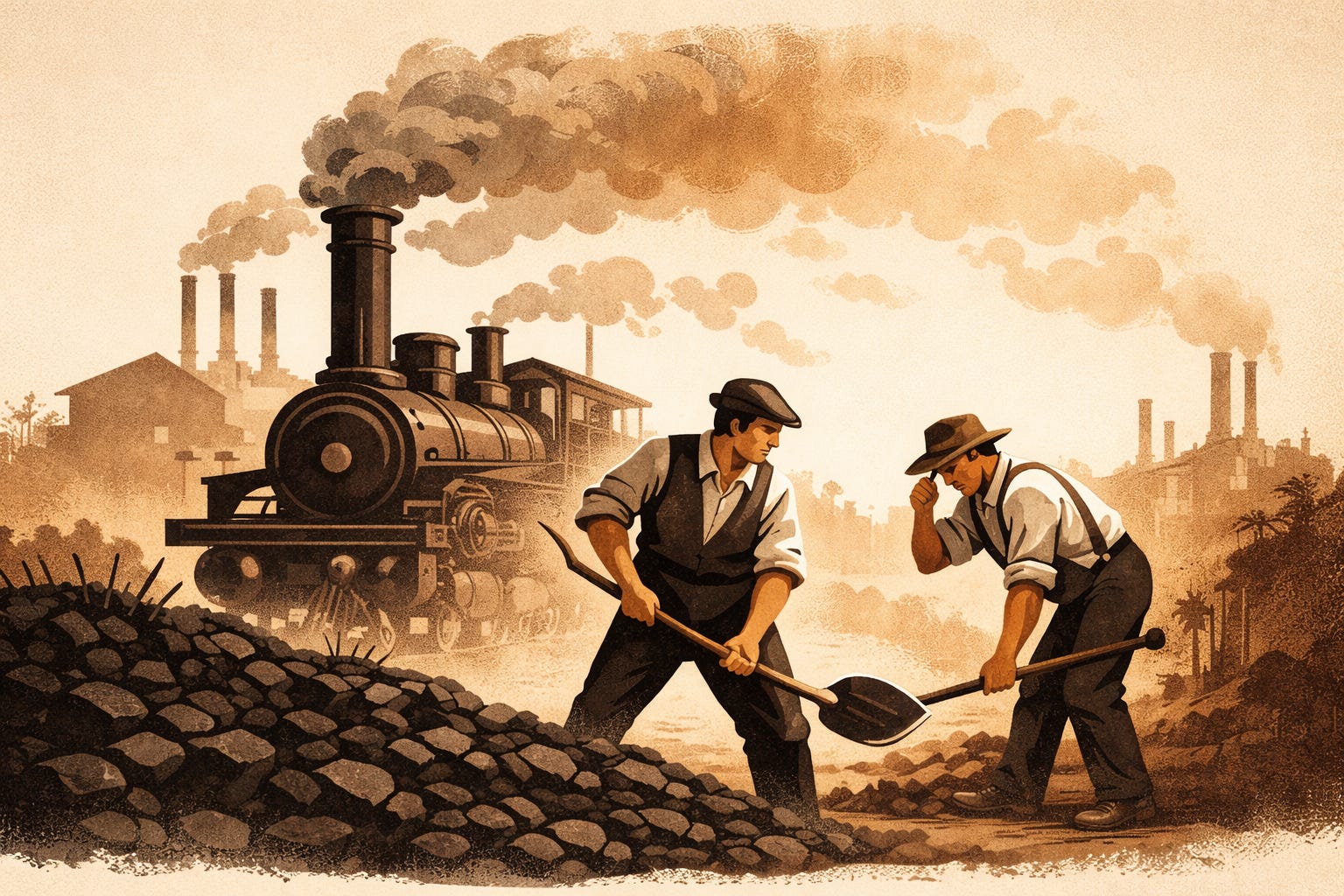
At the time, people were terrified. If one machine could do the work of 100 men, the math seemed simple: 99 people would be out of a job. This fear led to widespread protests. In the early 19th century, groups like the Luddites famously smashed textile machinery, fearing that automated looms would destroy their livelihoods.
If I had been living in that era, I probably would have been right there with them. If your entire life is built on a specific physical skill and a machine suddenly does it better, fear is a natural response.
But looking back, we don’t regret the “loss” of back-breaking manual labor. We appreciate the convenience of the modern world that those machines built.
History shows that every technological leap triggers fear before its benefits become clear. We are watching that same cycle play out again today.
The Modern Resistance - Cones and Cabs
We see this same pattern today with autonomous vehicles. Self-driving cars have become one of the most protested technologies in recent years.
In San Francisco, activist groups like “Safe Street Rebel” began a campaign of “coning”, placing traffic cones on the hoods of Waymo and Cruise vehicles to “brick” them and shut them down. Organized labor unions and taxi associations joined the fray, arguing that the expansion of autonomous vehicle permits would lead to mass unemployment for low-income workers and drivers.
Whenever a technology directly impacts a person’s safety or their immediate paycheck, it leads to a battle. AI is no different; it’s just the newest front in a very old war.
The Shift from Physical Muscle to Mental Might
What makes humans unique is our combination of physical and mental ability. For the last two centuries, we used technology to automate our physical limitations. We stopped using our backs to lift rocks and started using engines. We liked the convenience, even if we feared the change.
Now, it is the “mental muscle’s” turn.
Today, the most high-paying jobs require deep, specific knowledge and the ability to make complex decisions. Because of AI, machines can now analyze vast amounts of data and make those decisions in a fraction of a second. This is why it feels so personal this time, it’s affecting “mentally exhaustive” jobs, including my own as a Software Development Engineer.
At Amazon, I see this every day. Tools that we use for software development can now complete tasks in minutes that used to take me two full days of coding and debugging. Our “speed to delivery” is getting faster, much like that steam shovel lifting rocks.
A Gift for the Year 2125
The next 5 to 10 years will be a period of intense transition. It won’t be easy. However, if we look a hundred years ahead, I believe we will be seen as one of the greatest generations in human history.
Our children, grandchildren, and great-grandchildren will be thankful that we had the courage to launch this technology. We are moving toward a world where human potential isn’t spent on repetitive mental tasks, but on higher levels of creativity and connection.
If you’d like to hear my thoughts on what the world will actually look like in the year 2125, leave a comment below and I’ll dive into that in my next post.
I send out Master Mentee 🎓 weekly with curiosity and a passion for growth. If you’re enjoying it, I’d be grateful if you shared it with a friend who’d appreciate it too.
Not subscribed yet? Join the growing mentee squad of curious minds.
✨ Get the next issue in your inbox:
💚 If this resonated, tap the 💚—it’s free for you, but it supports my work and helps Master Mentee reach more amazing people like you.
