

Last week, I wrote about the personal side of reverse culture shock.
This week, I want to talk about work.
I spent nearly five years at Amazon US before moving to Amazon India.
Same employer.
Same leadership principles.
Same performance reviews.
Same engineering bar.
Yet after just a few weeks, it felt like I had joined a different company.
Not because Amazon had changed.
Because culture had.
I’ve started believing that culture is the operating system. The company is just the application.
The application stayed the same.
The operating system didn’t.
My first culture shock happened before anyone arrived.
On my third day, I reached the office at 9:00 AM.
The lights were on.
The coffee machine was running.
The cafeteria was open.
The office wasn’t.
Almost nobody was there.
I checked Slack.
Silence.
For a moment, I wondered whether I’d accidentally come in on a holiday.
Later that morning, one of my colleagues smiled and said,
“This is completely normal here.”
That was the moment I realized I had moved countries, but my internal clock hadn’t.
For five years, my mornings started early.
Now I was the only one following that schedule.
Ironically, a month later...
I stopped coming at 9.
Reverse culture shock isn’t just learning new habits.
It’s slowly letting go of old ones.
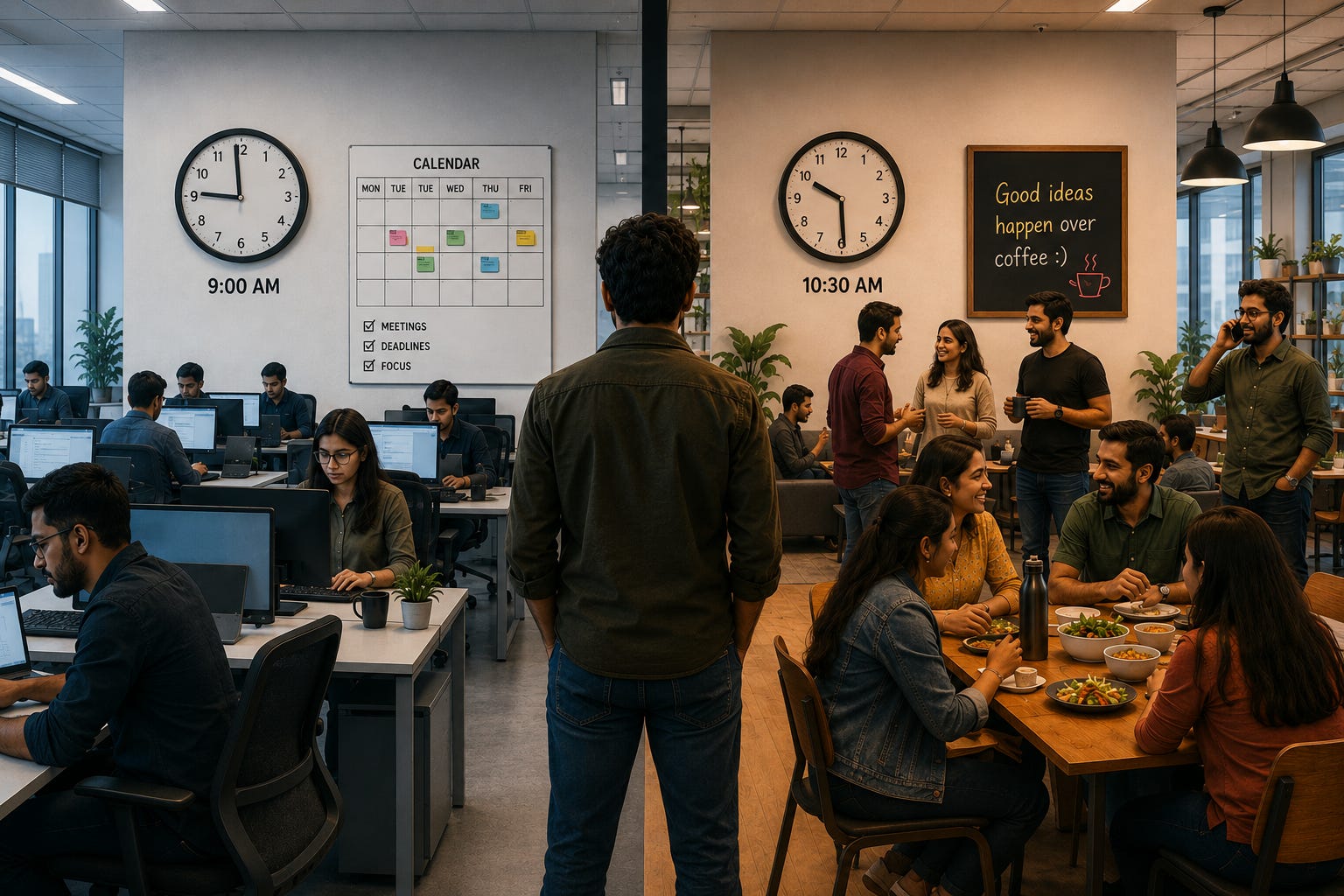
Lunch became my daily reminder that I had changed.
In the US, I naturally ate around noon.
Here, most of my teammates eat around 2 PM.
Two hours doesn’t sound like much.
But every day, I found myself sitting alone in the cafeteria.
At first, I thought,
“I’ll just wait.”
I never could.
My stomach was still living in Seattle.
It sounds like a small thing.
But culture often hides inside small things.
Not holidays.
Lunch breaks.
Meetings taught me that time has different meanings.
One thing I quickly noticed was how differently people treated calendars.
In the US, if a meeting starts at 10:00, people usually join at 9:59.
Being on time is almost an unwritten rule.
Here, meetings often begin a little later.
And unlike what I was used to, they frequently run beyond their scheduled end time as well.
At first, that bothered me.
Now it doesn’t.
Not because meetings changed.
Because my expectations did.
The biggest surprise wasn’t work.
It was relationships.
During five years in the US, I almost never exchanged personal phone numbers with colleagues.
Slack.
Email.
Chime.
That was enough.
Here, sharing phone numbers is completely normal.
Managers call.
Teammates call.
Work flows naturally into personal communication.
I’ve chosen to keep my own boundary and still prefer messaging first.
But I also understand why many people don’t see that boundary the same way.
Different cultures optimize for different things.
One optimizes for personal space.
Another optimizes for accessibility.
Neither is objectively better.
They’re simply different.
One conversation made me genuinely uncomfortable.
It was an intern’s last day.
People started asking about the internship.
Then the questions became surprisingly direct.
“Who was the worst Senior Engineer L6?”
“Tell us three good things and three bad things about your manager.”
Everyone laughed.
The interns answered.
But I noticed something else.
Their voices became quieter.
The people they were talking about were sitting right there.
Including their manager.
I kept wondering how I would have answered that question as an intern.
I’m still not sure.
Then there were the late-night meetings.
One thing I appreciated in the US was predictability.
Most meetings were over by 5 PM.
Here, I’ve heard stories of meetings continuing at 2 AM to accommodate global teams.
Does everyone work insane hours?
No.
That’s actually one misconception people outside India often have.
But global collaboration does create schedules that can stretch far beyond the traditional workday.
It’s less about working harder.
More about working across more time zones.
What surprised me in a good way
Not every difference made the adjustment harder.
Some made it easier.
People spend more time talking before meetings.
Lunches are longer.
Conversations are more spontaneous.
Someone drops by your desk just to chat.
Teams celebrate together.
Food is better.
Relationships feel warmer.
It reminded me that productivity isn’t the only thing workplaces optimize for.
Sometimes they optimize for belonging.
The biggest lesson
When I first moved back, I kept asking,
“Why is everyone doing this differently?”
A few weeks later, I started asking a better question.
“Why do I assume my way is the normal way?”
That’s when I realized something.
I thought I knew my own country.
Five years abroad had quietly taught me a different set of invisible rules.
Coming home wasn’t about remembering India.
It was about unlearning America.
And that’s what reverse culture shock really is.
Not forgetting one culture.
But discovering that you’ve become part of another.
I’m curious.
For those who’ve worked in multiple countries:
What invisible workplace rule surprised you the most?
I’d love to hear stories from places beyond India and the US.