

Yesterday I watched a 20-year-old classic: The Pursuit of Happyness.
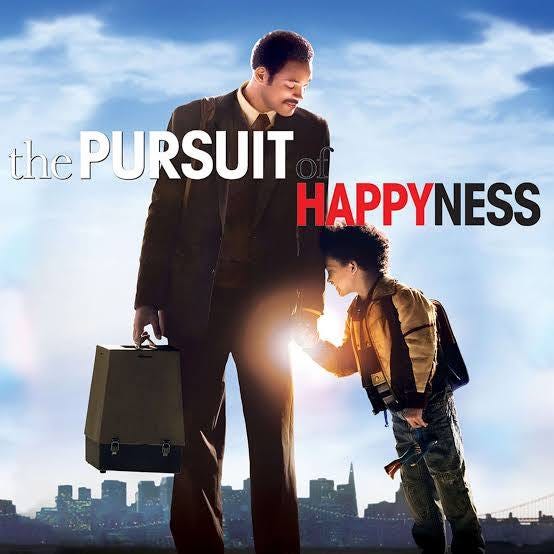
It stopped me in bed.
Not because of the big ending. Because of the small scenes. The unpaid Dean Witter internship. Sleeping in a BART bathroom with his son. The paint-stained interview. The father who refuses to turn hardship into anger.
Chris Gardner gets hit again and again - right when things start to look up. Most people in his shoes would become bitter.
He doesn’t.
In the film’s quiet thesis, Gardner wonders about Thomas Jefferson and the Declaration of Independence:
“How did he know to put the pursuit part in there? That maybe happiness is something that we can only pursue…”
That line hit me harder than the Oscar-bait ending.
I was him in my early 20s. And the struggle started long before that.
1. Hardship doesn’t require a hard personality
I can imagine almost anyone in Gardner’s position becoming irritated, agitated, and angry all the time. Life throws a hard ball the moment things look good.
But Gardner keeps walking. He protects his dignity. He protects his son. He protects the dream.
“You got a dream, you gotta protect it. People can’t do something themselves, they want to tell you you can’t do it. You want something, go get it. Period.”
That hit close to home. The financial struggle was real. I had to find ways to earn money. And I was always pulled toward computers and the internet.
2. The night I broke my father’s laptop
I was 12 when my father bought a Lenovo laptop.
In India then, a laptop wasn’t “a gadget.” It was luxury. Closer to a cleaning robot or VR headset.
I wanted to help him. Viruses were everywhere. Antivirus subscriptions were expensive. So when a friend’s brother offered a “free” install file, I felt like a hero.
I plugged in the pendrive. Installed. Rebooted.
The laptop froze.
No touchpad. No keyboard. No restart. No shutdown. Just a dead machine until the battery died.
I cried myself to school the same day. My father worked late nights on that laptop. I was sure I’d destroyed everything. I wasted all those father’s night.
You might wonder how “antivirus” freezes a laptop. Twelve-year-old me had a conspiracy theory: antivirus companies spread viruses to win customers. Looking back, it was almost certainly malware dressed as help. The lesson wasn’t tech. It was what happened next.
My father didn’t yell.
He didn’t shame me.
He said: We’ll get it fixed. If not, we’ll buy another one.
We did get it fixed. No data lost.
And that soft landing lit a fire. I didn’t run from computers. I ran toward them. I needed to know how they worked and what they could do to a life.
Psychologist Carol Dweck’s research on growth mindset helps explain why that moment mattered. When adults treat mistakes as recoverable, not as proof you’re “bad” -- kids stay curious instead of collapsing into shame.
My father gave me a soft landing. Curiosity did the rest.
I later saw the same trait in Chris Gardner: do the hard thing without turning your pain into punishment for everyone around you. Life can go wrong. Every move can veer off course. Character is how you respond.
3. When family finances collapse, the mind goes into survival mode
Few years later, my father got a chronic illness. Hospital bills crushed the family income. Savings started to look temporary.
So I started saving. Thinking twice before eating out. Hunting deals to buy stuff cheap. Finding money where most people only saw apps.
Behavioral science has a name for that pressure. In a famous Science study (Mani, Mullainathan, Shafir & Zhao, 2013), researchers found that money worry can tax cognitive bandwidth, roughly like a 13-point IQ drop or losing a night of sleep.
Scarcity doesn’t only empty the wallet. It captures attention.
That was our house. Survival first. Ambition second.
India’s new application market boom had one loud game: refer and earn.
I played it hard.
I promoted apps while studying full-time. Resold rewards in the secondary market. Then came LINE’s big scheme:
Every 25 referrals → bonus
At 300 referrals → a new iPhone
25 was easy. 300 was war.
I hit the milestone. Held the iPhone. My sister wanted it but we sold it for the money our house needed.
Then I did it again, not on one account, but more than ten. Then I moved into direct dollar payouts for installs. Enough to keep the house running, paying hospital bills and tuition fees.
In Gardner’s language: this was the unpaid internship season of my life. Ugly work. Necessary work. Not glamorous. But forward.
4. Progress has a bill - pay attention to which one you’re paying
But progress has a bill.
I failed two subjects in my first college semester.
That was the fork.
If I kept grinding referrals at full speed, I might have saved more months… and lost the path that later led me to Amazon.
So I stopped. Recalibrated. Kept moving, just in different direction.
This is the part inspirational movies sometimes skip: the edit.
Hustle without a steering wheel becomes self-sabotage. Gardner didn’t only grind. He chose the path with the highest long-term compounding, the brokerage seat, even when it meant unpaid months and sleeping on bathroom floors.
“Don’t ever let somebody tell you you can’t do something. Not even me.”
— Chris Gardner to his son
The quieter version for students and early-career hustlers:
Don’t let short-term survival tell you that long-term self-destruction is “necessary.”
The Soft Landing Rule (a simple mental model)
Chris Gardner taught me one thing the movie never says out loud:
Hard life does not require a hard personality.
Most people turn pressure into anger. Anger into bad decisions. Bad decisions into more pressure.
The successful ones do something else:
Take the hit without becoming the hit. Life can be unfair. You don’t have to mirror it.
Turn soft landings into fuel. My father’s calm didn’t erase the mistake. It converted shame into curiosity.
Hustle for survival — then edit for the future. Referral schemes paid bills. Stopping them protected the career. Both mattered. Timing mattered more.
Walk forward in baby steps. Not every stride has to be dramatic. Forward is forward.
Call it the Soft Landing Rule:
When life throws the hard ball, respond soft enough to keep learning — and firm enough to keep moving.
Chris Gardner slept in bathrooms and still showed up like a professional.
My father faced a dead laptop and still chose repair over rage.
We faced hospital bills and still chose curiosity over bitterness.
One question to keep (and one research-backed reminder)
The next time life hits you mid-progress, ask:
Am I about to harden… or land soft and walk forward?
Cornell psychologists Thomas Gilovich and Victoria Medvec (1994) found a painful pattern in regret:
In the short term, we regret what we did; in the long term, we regret what we didn’t do. Action stings now. Inaction haunts later.
So protect the dream. Take the baby step. Edit when needed. Keep walking.
Because happiness isn’t a finish line you own.
It’s a pursuit you practice. Every ordinary day you refuse to quit.
“Walk that walk and go forward all the time. Don’t just talk that talk, walk it and go forward. Also, the walk didn’t have to be long strides; baby steps counted too. Go forward.”
― Chris Gardner, The Pursuit of Happyness

I send out Master Mentee 🎓 articles with curiosity and a passion for growth. If you’re enjoying it, I’d be grateful if you shared it with a friend who’d appreciate it too.
Not subscribed yet? Join the growing mentee squad of curious minds.
✨ Get the next issue in your inbox:
💚 If this resonated, tap the 💚—it’s free for you, but it supports my work and helps Master Mentee reach more amazing people like you.