

You can build a WhatsApp clone with one prompt now.
You can’t safely change one feature in a product people already use.
I found that out on my current project at Amazon.
And I think it points to who wins next.
Why I think big tech is heading for trouble
I think this is hard to avoid. The hyperscalers are spending enormous amounts on AI. At some point, someone has to pay for it and ask return on it.
When that gets tight, I expect more layoffs again. The job security we thought we had at big tech will feel scary once more. Although, we are already at there.
One fact scared me. People assume the AI labs live on subscriptions. They don’t. About 80% of Anthropic’s revenue comes from enterprise and startup API calls, according to the research firm Sacra.
Many of those startups are alive because of venture funding. If that funding goes, that revenue goes with it. Then overall AI investment goes down, hyperscalers included.
It is a chain. Startups pay the labs. The labs and the hyperscalers spend as if that money will keep coming. If one link slips, every link feels it.
That is my read, not a forecast.
But when big companies get into trouble, a door opens for people who want to start something. Why?
Because building anything is cheaper now. And it will get cheaper more.
Give Claude or ChatGPT a prompt, and it will build you a WhatsApp. But maintaining something that already exists is a different story. With AI, it is incredibly hard.
Building happens once. Maintaining happens every day, for every user who depends on it.
What I learned on a live project
I can’t share the details of my project. Here is the shape of it.
Last few months, I worked on greenfield projects. No customers. No users. I pushed commits, deployed, and then tested. Nobody was relying on it yet.
This one is different. I had to update an existing feature. It was connected to several services, so there were many places where I could make the change.
Where you make it matters. The feature has to stay extensible. And the most important rule is simple: do not break what already works.
That takes a lot of time. Before I touch anything, I have to be sure every feature around that code path is not affected.
On a blank page, a wrong guess costs nothing. On a live feature, a wrong guess reaches real people. That is the difference I feel every day now.
I once wrote that speed is real when nobody is using it yet. This project is the other side of that sentence.
Here is what I do now:
I rely on the existing unit and integration tests.
Some services don’t have complete tests. So I read every line the AI wrote. It is slow, and I don’t see a shortcut.
I get it reviewed by an engineer who knows about it.
After deploying, I keep monitoring. The new feature and the old ones.
Then update to the customers
Why big companies can’t move fast
Take WhatsApp. Meta runs it for billions of users. Those users expect everything that is already there to keep working. So Meta cannot afford downtime just to move fast to release new features.
Now picture a new WhatsApp with a hundred users. Nobody depends on it yet. To win market share, it needs features the big product does not offer yet.
There are plenty of gaps. It can ship a feature on Monday and fix it on Tuesday. If it breaks, almost no one is there to notice.
Facebook, now Meta, learned this years ago. In 2014, Mark Zuckerberg told WIRED:
“We’ve changed our internal motto from ‘Move fast and break things’ to ‘Move fast with stable infrastructure.’”
He admitted it means moving “a little bit slower upfront.” That is the right call for billions of users. It is also the opening for everyone else. Speed and scale pull in opposite directions.
Look at Outlook. On November 12, it went down, and employees, businesses and many governments lost email for nearly 24 hours.
Microsoft later said a latent bug from July was behind it. When a product that big fails, millions of people feel it.
That is what a big company is protecting every day. And that is the job for many engineer’s every day. Sometime they fail too.
Will startups hit the same wall?
Fair question. Once a startup has users, won’t it face the same problem?
I think they stay one step ahead. They are building everything with AI.
AI writes the code, and AI maintains the code.
Big tech’s code was written by humans, for humans to read. A startup’s AI features and workflows are AI-native from day one. And AI is faster than any person at writing words and lines of code.
So the hyperscalers get slower, and the new teams get faster. That is the gap I am watching.
That is my bet. Not a promise.
What I’m taking from this
If you have been waiting for the right time to build something, I think this is it.
If the hyperscalers struggle, the openings will not come from inside them. They will come from people who start small.
I have written before that I’m helping my wife with any tech she needs. I’m also thinking about building for the Master Mentee squad. Keep in mind:
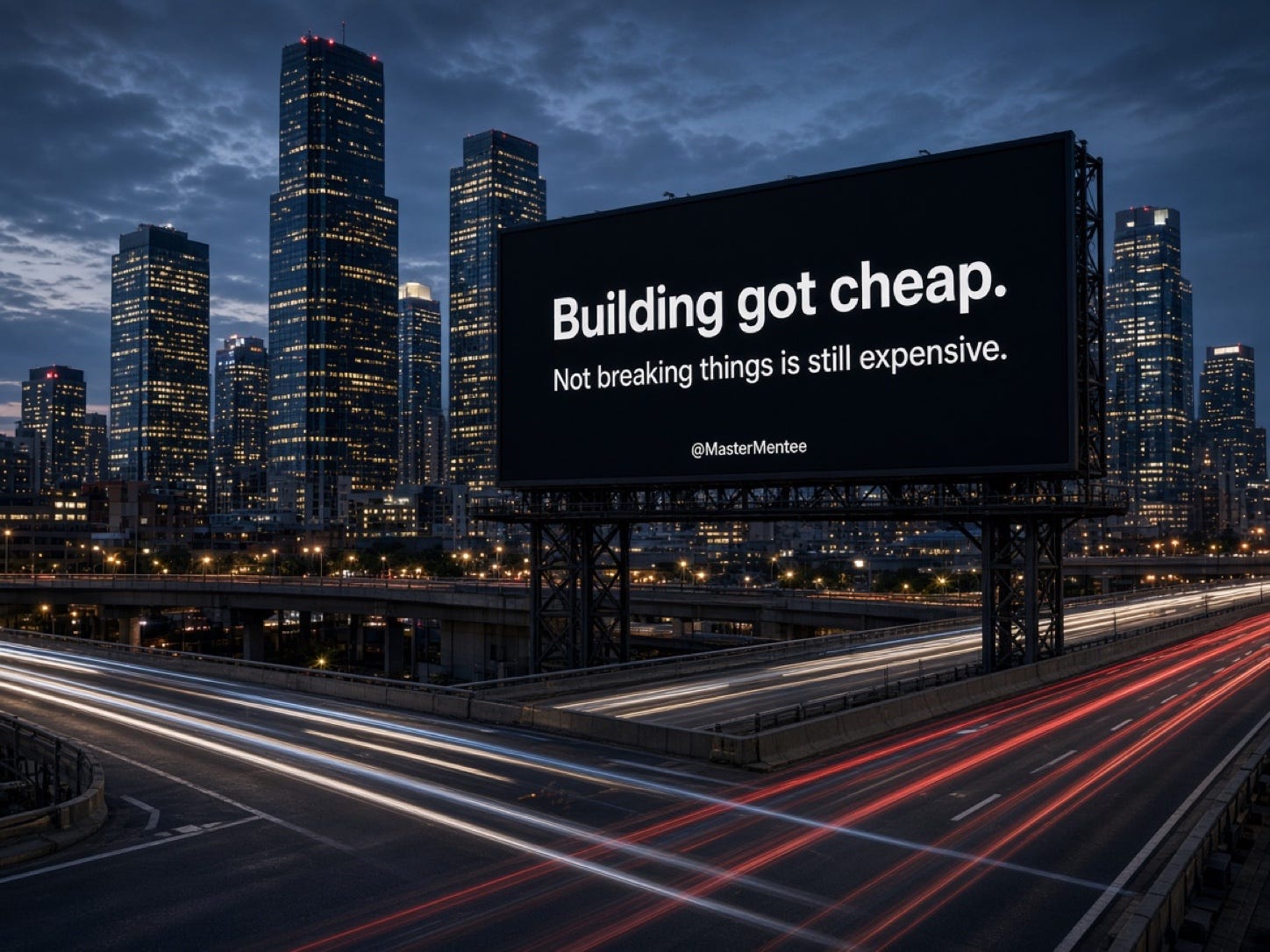
Building got cheap. Not breaking things is still expensive.

I send out Master Mentee 🎓 articles with curiosity and a passion for growth. If you’re enjoying it, join the growing mentee squad of curious minds.
💚 If this resonated, tap the 💚—it’s free for you, but it supports my work and helps Master Mentee reach more amazing people like you.